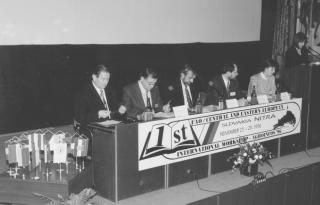
 The
first international conference in agricultural informatics bringing together
FAO Rome and the states of central and eastern Europe took place from the
25th to the 29th of November 1996 in Nitra, Slovakia.
The
first international conference in agricultural informatics bringing together
FAO Rome and the states of central and eastern Europe took place from the
25th to the 29th of November 1996 in Nitra, Slovakia.
The
first international conference in agricultural informatics bringing together
FAO Rome and the states of central and eastern Europe took place from the
25th to the 29th of November 1996 in Nitra, Slovakia.
AGROINFOS is the name for the yearly meeting of Slovak agricultural information specialists. 1996 was a break-through year for the conference. A workshop for national specialists grew into an international gathering. AGROINFOS '96 was organised by the Institute for Scientific and Technical Information for Agriculture, UVTIP Nitra, with the help and cooperation of FAO Rome. It was held under the name "The Cooperation of the FAO with National Library Information Systems", and took place in the city called "the Mecca of Agriculture" in Slovakia. Anton Mangstl from FAO Rome, Zbigniew Karnicki from FAO sub-regional office in Budapest, Jan van der Burg from IAALD, and I. Thysen from EFITA met with heads of national agricultural information institutes in France, Belarus, the Czech Republic, Poland, Albania, Latvia, Lithuania, Russia, Moldavia, Bulgaria, Croatia, Ukraine, and Slovakia to discuss the state of agricultural informatics domestiically and internationally.
The opening addresss on Day 1 was delivered by a representative of the Slovak Ministry of Agriculture, who spoke on the new directions and tasks of information systems. Afterwards presentations were made on "The Current State of IIS VTEI in Slovak Agriculture". Fifty-five Slovak information specialists from agricultural research institutes assessed the state of informatics at their workplaces.
The main emphasis of Day 1 was on UVTIP's presentation of its activities and organisational structure.
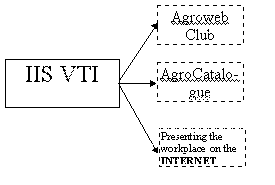
*Integrated Information System for Scientific and Technical Information
The greatest care and attention was devoted to the IIS VTI project.
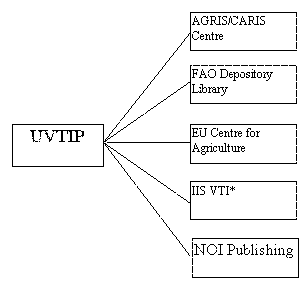
For the building up of the AgroCatalogue the MICRO CDS/ISIS database software system was chosen, based on the ADEM 3.9+ (data writing) and IRIS (for searching). The AgroCatalogue is being built with the co-operation of 15 agricultural research institutes and is available through the database centre CEDAR in Vienna.
On the second day the international conference got underway, under the
title "The Activity of International Organizations in the Building of National
Information Systems". English was the working language. The speech of Anton
Mangstl (head of WAICENT at FAO Rome) on the world network of information
systems for agriculture was received with great interest.
The structure and activity of IAALD (International Association of Agricultural
Information Specialists) was presented by the president of the association,
Jan van der Burg. He also sketched out the possibilities for cooperation
for member countries and the need for establishing regional centres for
improving communication between experts.
The founding, short history and outlook for EFITA (European Federation of Information Technology in Agriculture) were covered by Iver Thysen, the organization’s Danish founder.
In the afternoon session representatives from 12 countries described their activities. Most of their institutions are linked up internationally through national FAO Depository Libraries and national AGRIS/CARIS centres, or are partners in the building of special databases at FAO Rome.
The specialist program of the conference was complemented by excursions to the national AGRIS centres and FAO Depository Libraries in Budapest (Orszagos Mezogazdasagi Konyvtar es Dokumentacios Kozpont), Vienna (Universitats bibliothek Bodenkultur) and Nitra (UVTIP).
Professional isolation within the countries of central and eastern Europe is a recognised barrier to the development of the informatics profession. Realising this, the workshop participants appreciated the intention of the organisers to develop a forum for regular professional meetings through the AGROINFOS workshops in Nitra, which would become a vehicle for passing on information on the development and utilization of information and communication systems and technologies serving agriculture.